Read Sing Play

Adventures in early literacy


3 Comments

School Visit Success

You know your visit was successful when you hear them whispering things like “She’s so nice!” and “Will your mom take us tonight?” in the hall on their way back to class.

In general, I feel like I’ve been lucky with summer reading school visits. The kids are always enthusiastic and lots of them come in and say hi during the summer.

Despite this, I definitely have a strong preference for 4th and 5th graders. There’s nothing better than a room with 50 4th and 5th graders all raising their hands at once to suggest different things that might count towards their reading goal. Or the 10 that crowd around me as I’m packing up to tell me jokes and tell me they want to be a librarian, too.

OR when you tell them you’re about to read something scary so they might want to close their eyes, and they do. Magic.

Here’s what’s in my box of tricks for every visit for these older kids:

-Summer Reading game board, bookmarks, stickers, and any other paper I need to show them.

-cool non-fiction: What’s Up Cupcake? by Dana Meachen Rau, A Little Book of Sloth by Lucy Cooke, a Haunted Caves book, Ripley’s Believe It or Not!, and a book of optical illusions done by National Geographic

-playaways and playaway views

-a magazine (I grabbed National Geographic for Kids today and they dug the polar bear on the cover (see what I did there?))

-picture book (to remind them they can read to their little siblings and that books with pictures still count no matter how old you are)

-popular chapter books or ones I can book talk easily: Spaceheadz, Origami Yoda, Incorrigible Children of Ashton Place, Half-Minute Horrors-I ALWAYS read some of these and they always love it

-graphic novels: Bone, Babymouse (they ALL remember reading those!)

-comics: Garfield is a sure thing

-joke books: these are the golden ticket to their hearts. The worse the jokes, the better. Their favorite joke from today: “What do you call a fly without wings?” A walk. HAR HAR HAR

After my spiel I always “quiz” them to make sure they were listening. The best question to ask is your name. They will ALL remember you after that question. I usually give them stickers and/or bookmarks for getting the answer right and they get really in to that.

What do you do for your summer reading visits?


4 Comments

Books are Not Just for Reading: My First Presentation

Can’t believe I’m JUST getting to this! I did the presentation the first week in April!

The presentation was part of Tapestry, an Early Learning conference for Southwest Washington. According to one of the conference chairs (who also happens to be my boss!) the conference was not as well attended as in the past, and that’s really too bad because there were a lot of GREAT looking programs. I didn’t get to go to any since I was presenting the whole day, but man, the descriptions sounded awesome.

Even though I did two presentations, really workshops, there was some overlap. That was OK, though because there were different people in each workshop (except one who was with me all day!).

Here are my original outlines, done through Evernote (thanks Mel for that idea):

Books Are Not Just for Reading Outline

Read Sing and Play with Infants and Toddlers Outline

Set up: in each room I set books up for display all around the classroom (used the marker holder on the white boards) for browsing before and after the session. This was a feature participants really seemed to love. The props I brought were on display at the front of the room and available for “petting” after the session. Handouts were on a counter by the door for taking as they came in or left.

Presentation #1: Books Are Not Just for Reading

This one was originally intended to be specific to infants and toddlers, but there was a mistake on the program so it was listed as being for preschoolers and kindergartners, too. I brought along several books for older kids with a few ideas for ways to use them besides straight reading, so no biggie.

Having been to many, many presentations over the years I know the ones I’ve learned the most from included lots of audience participation. So, as people came in I handed them a book and a piece of paper. I tried to match the book to the ages each participant works with, which was a great opportunity to learn more about each participant right away.

After introductions they had 3 minutes to look through their book and write down ways they thought they could use it besides straight reading.

Then I wrote what they came up with on the white board.

booksnotforreading

We talked about each of the things they came up with and I added or embellished a few as we went along, and clarified and grouped them in to main ideas (on the left). I loved that they thought of things I hadn’t-using a book for crowd control, yes!

Now time for demonstrations! I spent about 20 minutes showing them various ways to “extend” a picture book. I even addressed ways they could use a book for crowd control since that was something they suggested. In toddler storytime I use a song book (usually something by Jane Cabrera) right after our prop activity to calm everyone down and get storytime wrapped up. It works every time!

Ways to use a picture book: sing it, dance with it, bounce to the rhythm, picture walk, flannels (and cookie sheet magnet boards), instruments, show pictures with music cd playing, puppets, signing, eBooks (Tumblebooks), play with it (flap books and more!) and act it out.

Next I put them in groups and asked them to work together with the books they had from the beginning to come up with activities they WOULD use in their classrooms. I wanted them to be able to walk out the door with some practical ideas they knew they would and could use. Taking the planning step out makes it more likely they will use what they learned.

They all wrote down TONS of ideas. One was reading Old Black Fly by Jim Aylesworth to Kindergartners armed with flyswatters and asking them to wave the swatters at the book on the Shoo Fly part. Then follow with dancing to a version of Shoo Fly and art with the flyswatters. Sounds like a great time to me! Others included sharing Piggies by Don and Audrey Wood with toddlers and then doing This Little Piggy on their fingers; singing Brown Bear, Brown Bear followed by an art project with paint to talk about the colors they saw in the book; and sharing Dancing Feet by Lindsey Craig (dancing all the while, of course!) followed by art with different mediums like the ones in the book (corrugated cardboard was the one they were most excited about).

My goal was for participants to leave with practical ideas to apply to their classroom and to feel comfortable using books in many ways. I felt like the presentation was a total success (and the evaluations said they liked it!). They left smiling and with lots of ideas written down on their notes.

Presentation #2: Read, Sing Play with Infants and Toddlers

My goal for this session was to put all the stuff I do in baby and toddler storytime and share on this blog, in a presentation. There were a few things I had to tweak from my original outline (there was NO way to get the parachute out in that classroom due to the number of desks, for example) but overall I think it went well. Two hours is long time to sing, rhyme, read, and play with a small group of grown ups. Still, I think we all had fun and we all learned lots of songs and rhymes to use with real, live kiddos!

Program description: Music and rhythm activities for infants and toddlers using books, props and our bodies.

I started similarly to the first presentation by introducing myself and asking them to do the same. Only this time I asked them to share their current favorite song, rhyme, or music activity in their classroom. A couple of them had the same favorite: Wheels on the Bus, with a twist (animals, etc. on the bus).

Here’s their list:

songs

Before going any further we all had to learn these songs. I, for one, did not know the Firetruck Song! Toddlers + Firetrucks = WIN.

Next I asked them why they thought music and rhyming was important for babies and toddlers (see what they came up with below) and talked to them about the importance of music for the littlest kids (you can see all the stuff I talked about in my outline). I didn’t want to go on about this forever because this was the after lunch session and I got the feeling they were much more interested in learning rhymes, songs and techniques to take away than the philosophical stuff. Plus, based on their responses to why music is important, they already know why to do it. They needed the how, the practical part.

whymusic

I talked a little about how to choose appropriate recorded music: if there are actions to follow they need to be slowly paced, find songs that are relevant to their lives (Firetruck song!), music you enjoy as well so you’ll be more likely to want to play it. For other songs and rhymes they should be easy to sing, repetitive, and fun! Songs to work on self regulation are great (stop and go, sit and stand, etc.) and simple movement rhymes (wigglers) are great for toddlers and most bounces or tickles are appropriate for babies and toddlers.

For learning rhymes and songs, each participant received a shaker, scarf, and paper sun glued to a craft stick (for You Are My Sunshine). For any activity involving the parachute I asked them to use their scarf instead.  We spent the last hour rhyming, singing, tapping, playing and dancing. I started by demonstrating a lot of the same things from my first presentation (this was the overlap) like reading Monkey and Me by Emily Gravett to be a bounce and doing a 5 or 3 little anythings to the same tune of 5 Green and Speckled Frogs or 5 Little Monkeys, or to a rhyme (they all left with directions to access Flannel Friday for a plethora of counting rhymes).

They were each given a rhyme sheet to take with them so after my demo we learned all the songs and rhymes on that sheet, plus some. We had to do them each 3 times, of course, to learn them better, just like we would with children.

It’s a Wrap!

At the end of each session I gave them information about how the library can help them, how to get an educator card, etc. and handed out a resources postcard with info about Flannel Friday, web resources and library resources, rhyme sheets, and a booklist (I’m happy to share any of these documents, just let me know!). Then there was time for questions and general after program chatting. It was a lot of fun!


3 Comments

Baby Storytime: Art!

Inspired by Brooke to do art with babies, I decided to let the baby storytime folk get in on the storytime postcard project every storytimer in my library did for the last weeks of storytime. Basically, we take this awesome postcard with all the information for when storytimes start back up again in 5 weeks (!) and a spot for kids and parents to decorate and write their address. Then we mail the postcards to them! I’m not sure which of my clever co-workers came up with the idea, but it’s genius. First, everyone LOVES getting mail, especially when it’s informational. Second, everyone LOVES their kid’s artwork. So getting kids’ artwork in the mail? Pure genius, I tell you.

The front of the postcard (or is it the back?) looks like this:

photo

The older kids had markers and small stamps to decorate their cards, but for the toddlers and babies I went with jumbo washable stamp pads and oversized stamps (for toddlers) and their hands and feet (for the babies, mostly, though many a toddler contributed their adorable handprint). When doing this with the babies I passed out a tray with a jumbo stamp pad, postcard, and pen so each adult had everything they needed within reach. I also had a big container of wipes to pass around for wiping ink off hands and feet. I was sure to tell parents how completely washable the ink is (it is REALLY easy to wash off) so not to worry about it getting on our carpet or their clothes.

Here are some left behind examples from toddler and baby time.

image

postcard

I’m calling this a success and plan to do more art with the tiny guys-probably once a month to start. Can’t wait!


Leave a comment

Videos and Tips, Oh My!: Start with a Book Blog Tour

SWAB-blog-tour-graphic

So glad Amy at The Show Me Librarian invited me to participate in this blog tour. The Start with a Book site is a GOLD MINE! The following is a brief overview of a couple of features (there’s SO much on the website you could spend HOURS reading looking through it) I plan to incorporate into my library programs and services. So glad Amy of Show Me Librarian invited me to participate in this blog tour

Videos

There are many great videos on the site, like the one on the Fluent Kids of three girls reading The Wizard, The Fairy, and the Magic Chicken. I’ve been inspired to do reader’s theater with my parent/child book group this summer and share this video at the beginning of our meeting so the kids can get a better idea of how the process works.  While I have the website up on the screen, I’ll invite parents to go back to the Fluent Kids page when they go home. There are some great ideas for developing fluency at home (reread favorite books, of course!) and while I won’t have time to talk about all of them, I’m sure many parents will want to read the information on the site. I do plan to highlight the “Record It” (scroll down to that section) idea to let kids make their own audiobook. What a great way to practice reading and fluency, especially for those kids who love to be the star. We may even do that in book club…

Tips

The tip of the day is an AWESOME feature of the site. Not only do they prominently display the tip on the home page, but you can sign up for tips to be delivered to you via text. My first thought was to share these tips on Facebook once a week, or so, and in storytime, directing patrons back to the website to soak up more literacy information. These tips are written in English AND Spanish! This is especially helpful to me as my Spanish skills are super rusty, but I’d still like to offer quality literacy tips to my Spanish speaking parents. That just got a lot easier. I hope to include tips in Spanish appropriate to the younger set of children on my summer storytime handout. I also love that Start with a Book links to these tip sheets from their Reading Aloud page (in 10 languages other than English!). It’s wonderful having access to all these resources in one place!


Leave a comment

Baby Storytime: Pat a Cake

It’s been a while since I’ve done a baby storytime post-just not enough time in a day. Thanks for sticking with me!

What We Did:

Hello Bubbles

Penny Pointers

Zoom Zoom Zoom

This Little Train

Giddyap

Parent Message: It’s ok if they crawl around while we’re reading and rhyming. Just because they aren’t making eye contact, doesn’t mean they aren’t absorbing what we’re doing and saying. We want to make sure books and reading are FUN so we’ll let them participate at their own pace. You can just do what I’m doing if your little one leaves your lap.

Book: Monkey and Me by Emily Gravett (this is one I use ALL THE TIME because it is AMAZING)

Cover Art for Monkey and me

Pizza Pickle Pumpernickel

Bouncing Bouncing

Scarves:

Peek-a-Boo

Mix a Pancake

Roly Poly

Itsy Bitsy Spider

Book: Pat a Cake by Annie Kubler (I suggest substituting their baby’s name for “baby” and to mark their cake with the first letter of their baby’s name)

Cover Art Image

Group choices: Ram Sam Sam in #1, and Cheek Chin in #2

Cuckoo Clock

Goodbye Bubbles

Playtime!

Today’s agenda was packed! And so much fun!


2 Comments

School Age Program: Pranks and Gags

Jessica is back with a re-cap of the Pranks and Gags program she and a co-worker held last month. I, personally, had a great time! :)

On March 27th, we hosted a Pranks & Gags event during our school-age weekly program. We thought it would be fun to give the kids some ideas of harmless pranks for April Fools’ Day. The program was a lot of fun and we put the leftovers out on April 1st in the Children’s Department.

Free Brownies: Upon entering the room, there was a brownie pan covered with aluminum foil with a sign that said, “Free Brownies!” Inside were a bunch of die-cut brown construction paper letter E’s.

IMG_2821

Sponge Cake: We hot-glued sponge squares together to resemble a layer cake and had the kids decorate them with frosting and sprinkles.

IMG_2817  IMG_2824   IMG_2822

Un-openable Greeting Card: We put out construction paper and markers for the kids to make a greeting card, but we had them glue the inside together so they wouldn’t open.

IMG_2818

TP Message: We wrote funny messages on two-ply toilet paper with sharpies. The ink doesn’t run when placed in a toilet bowl.

IMG_2819

Water Ring: We made water rings from spoonful.com/crafts/water-ring using sponges, buttons, and pipe cleaners.

IMG_2823

Trick Questions: I compiled a list of trick questions titled “Super Hard Questions” for the kids to work on.

IMG_2825

We also printed out fake mazes, crosswords, and a memory game with no matches for the kids to work on from spoonful.com/printables/april-fools-prank-matching-game.  By far the most popular item was a self-inflating whoopee cushion we borrowed from a co-worker. I guess fart jokes never get old.

IMG_2820

Nope, they never do! Thanks, Jessica for sharing this program.


Leave a comment

Toddler Storytime: Farms and Negative Space

Did a theme again! I’m starting to freak myself out with all this themeing.

Books used:

I Spy on the Farm by Edward Gibbs (toddlers only)

Cover Art for I spy on the farm

Spots, Feathers and Curly Tails by Nancy Tafuri

Cover Art for Spots, feathers, and curly tails

Peek-a-Moo by Marie Torres Cimarusti (tiny tots only)

Cover Art for Peek-a-moo

Rhymes, songs, and fingerplays:

Hello Bubbles

Hands Are Clapping

Two Little Blackbirds (we’re still in a loft being loud and soft, at least until the parents learn some self regulation. The kids have it down!)

Old Macdonald had a Farm with finger puppets

Jump Like a Frog wiggler

Shakers:

Practice fast, slow, up, down, etc. for a minute then…

We’re Tapping by Kathy Reid Naiman

If You’re Happy and You Know It by Jane Cabrera, three verses

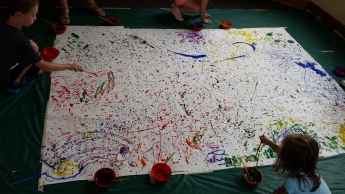
Art Activity: die cut shapes and dobbers for a negative space experiment. I don’t go in to any great detail explaining negative space to parents (just tell them that’s what the project is about, plus working on pre-writing skills with those dobbers!), but I really like this blog post about it, if any of you are interested. I got this idea from a colleague who did toddler storytime here before I did and love how fun and simple it is so we do it every couple of months now. Thanks, Heather!

I just set out all kinds of die cut shapes, tape, paper, and dobbers. I tell the parents to tape the shape to the paper (roll the tape and attach it on the back of the shape so it will come off more easily) and let the kids go crazy with the dobbers. When they are done, take the shape off and you can see the shape still! There are lots of oohs and ahhs after removing the shape. Parents definitely do a lot of guiding so the outline will get stamped, but I think it’s a great opportunity for them to work together to create something. The kid is doing all the work with parental guidance, which seems like a good thing to me!

Here are some left behind pieces of artwork to give you a sense of the activity:

photo   image